
Introduction
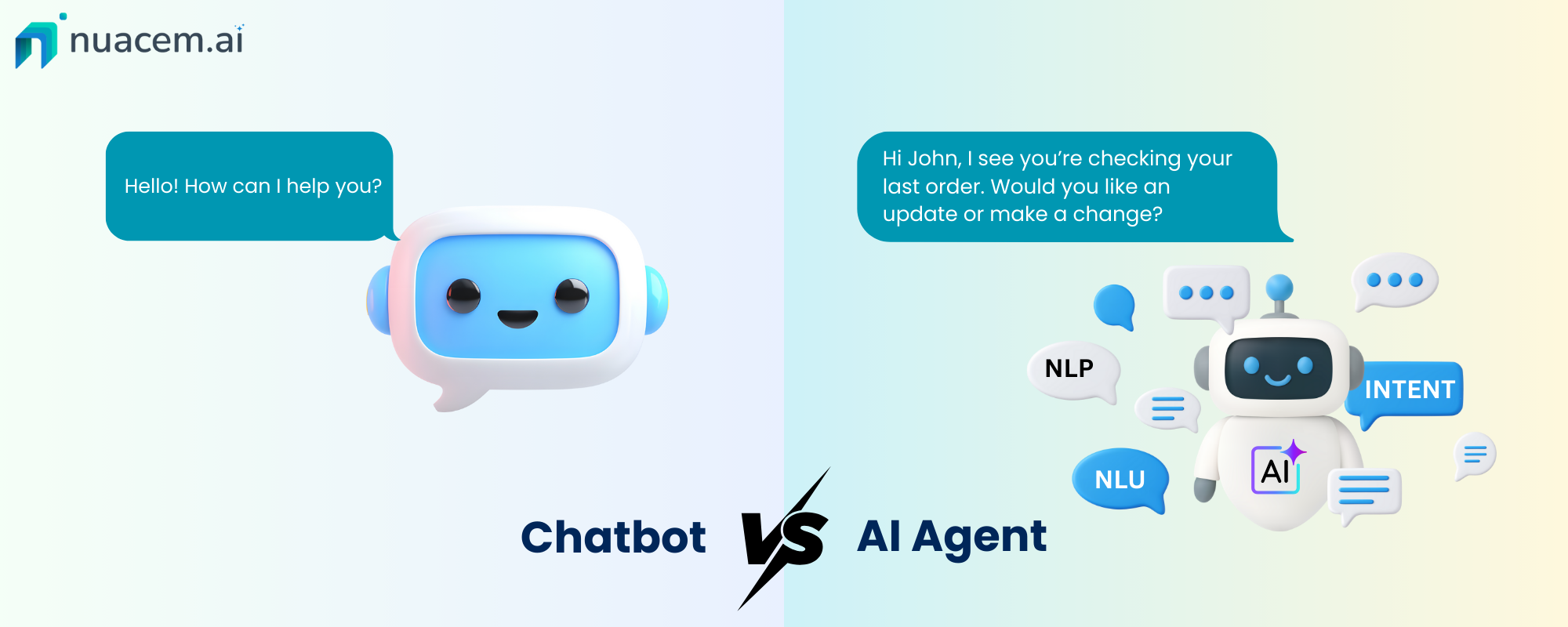
For many years, chatbots have been the face of automation in customer communication. They answered FAQs, handled simple queries, and reduced some workload for support teams.
But customer expectations have changed.
Today, customers want real conversations, faster resolutions, and actions, not just replies. This is where AI Agents come in.
While chatbots and AI agents may look similar on the surface, the difference between them is significant—and understanding this difference is crucial for businesses planning their next phase of digital transformation.
What Are Chatbots?
Chatbots are automated programs designed to respond to user inputs using predefined rules or scripted flows.
Key Characteristics of Chatbots:
Work on fixed rules or predefined conversation paths
Mostly handle FAQs and basic queries
Limited understanding of user intent
Cannot take complex actions
Break easily when conversations go off-script
Example:
If a customer asks:
“What is my order status?”
A chatbot can respond if the question matches a predefined rule.
But if the user asks:
“Can you change my delivery date and update my address?”
Most chatbots struggle, or immediately hand over to a human agent.
In short: Chatbots are good at answering, but not solving.
What Are AI Agents?
AI Agents are intelligent systems designed to understand, decide, and act.
They don’t just respond to messages—they analyze intent, understand context, and perform real actions across systems and workflows.
Key Characteristics of AI Agents:
- Understand user intent, not just keywords
- Maintain context across conversations
- Handle complex, multi-step requests
- Trigger workflows and system actions
- Operate across chat, voice, and messaging channels
- Learn and improve over time
Example:
If a customer says:
“I want to reschedule my delivery and change my address.”
An AI Agent can:
- Understand the intent
- Verify customer identity
- Update delivery date
- Modify address in backend systems
- Confirm the action—all in one conversation
In short: AI Agents don’t just talk. They take action.
Chatbots vs AI Agents: A Clear Comparison
| Aspect | Chatbots | AI Agents |
|---|---|---|
| Intelligence | Rule-based | Context-aware & intent-driven |
| Conversations | Scripted | Dynamic & human-like |
| Actions | Very limited | Can perform real actions |
| Learning | Static | Continuously improves |
| Use Cases | FAQs, basic support | End-to-end customer journeys |
| Enterprise Readiness | Limited | Built for scale |
Why Chatbots Are No Longer Enough
Modern enterprises face challenges that chatbots were never designed to solve:
Customers expect instant resolution, not redirection
Businesses operate across multiple channels
Support teams are overloaded
Manual processes slow down service
Disconnected systems break customer experience
Chatbots helped reduce some load—but they did not eliminate complexity.
AI Agents, on the other hand, are built to handle complexity by design.
Where AI Agents Create Real Impact
AI Agents are transforming multiple business functions:
Customer Support: Faster resolution, fewer escalations
Sales: Lead qualification, follow-ups, conversions
Operations: Workflow automation and task execution
CX: Consistent, personalized experience across channels
They act like digital employees—always available, always consistent, and always improving.
Are AI Agents Replacing Human Agents?
No. AI Agents are not replacing humans—they are augmenting them.
They handle:
- Repetitive tasks
- High-volume queries
- Routine workflows
This allows human agents to focus on:
- Complex issues
- Emotional conversations
- High-value customer interactions
- The result is a stronger human + AI partnership.
How Nuacem AI Is Building the Next Generation of AI Agents
At Nuacem AI, we believe the future is not about chatbots, it’s about intelligent AI Agents.
Our AI Agents are designed to:
-
Engage customers in human-like chat and voice conversations
-
Understand intent and context
-
Trigger real workflows and system actions
-
Operate seamlessly across channels
-
Deliver real business outcomes, not just replies
We are building an AI Agent–powered customer experience platform that helps enterprises move from automation to intelligence—and from conversations to outcomes.